
Life has a funny way of testing our need for control. You plan every detail of your career path, only to discover your true passion lies elsewhere. You map out your perfect relationship, then find love in the most unexpected place. You grip the steering wheel of life so tightly that your knuckles turn white, yet the most beautiful moments often arrive when you finally let go.

Surrendering to the universe doesn’t mean giving up or becoming passive. It means releasing the illusion that you control every outcome while staying aligned with your highest purpose. When you trust the process and allow universal guidance to flow through your life, you open doors to possibilities you never imagined.
This guide offers 10 practical tips to help you release control and embrace the art of surrender. You’ll discover how letting go can actually give you more power, peace, and joy than holding on ever could.
What Does It Mean to Surrender to the Universe?
Surrender is often misunderstood as weakness or resignation. In reality, it’s one of the most courageous acts you can perform. When you surrender to the universe, you acknowledge that there’s a greater intelligence at work—one that sees the bigger picture while you’re focused on individual puzzle pieces.

Think of surrender as dancing with life instead of wrestling with it. You still take action, make decisions, and pursue your goals. The difference lies in your attachment to specific outcomes. You do your best, then trust that what unfolds serves your highest good, even when it doesn’t match your original plans.
Universal guidance works through synchronicities, intuitive nudges, unexpected opportunities, and even challenges that redirect your path. When you’re open to receiving these messages, life becomes a collaborative effort between your conscious intentions and the universe’s infinite wisdom.
1. Practice Daily Meditation to Quiet the Controlling Mind

Your mind loves to create problems to solve. It generates endless what-if scenarios, contingency plans, and backup strategies. While planning has its place, excessive mental chatter blocks your ability to hear universal guidance.
Daily meditation creates space between you and your thoughts. Start with just 10 minutes each morning. Sit quietly, focus on your breath, and observe your thoughts without judgment. When your mind starts planning or worrying, gently return your attention to the present moment.
As you develop this practice, you’ll notice the difference between your ego’s demands and your soul’s quiet wisdom. The ego shouts about what you “should” do or what might go wrong. Your soul whispers gentle guidance about your next right step.
Many successful people credit meditation with helping them make better decisions. When you’re centered and calm, you naturally align with opportunities that serve your highest good rather than forcing outcomes that create struggle.
2. Let Go and Trust Through Journaling Your Fears
Fear often disguises itself as the need for control. You might think you’re being responsible by micromanaging every detail, but underneath lies anxiety about what might happen if things don’t go according to plan.
Create a regular journaling practice focused on identifying and releasing these fears. Write down what you’re trying to control and why. Ask yourself: “What am I afraid will happen if I let go?” Often, you’ll discover that your fears are based on old stories rather than current reality.
Once you’ve identified your fears, write about what trusting the process might look like instead. How would you feel if you knew everything was working out for your highest good? What actions would you take from a place of trust rather than fear?
This practice helps you recognize when control is coming from love (taking care of yourself and others) versus when it’s coming from fear (trying to prevent imagined disasters). Love-based action feels expansive and energizing. Fear-based control feels tight and exhausting.
3. Embrace the Art of Non-Attachment to Outcomes

Non-attachment doesn’t mean you stop caring about results. It means you care about the process more than the outcome. You give your best effort, then release your grip on how things unfold.
Start practicing non-attachment with small situations. Maybe you’re hoping for good weather for your picnic or wanting a particular parking spot. Notice how attached you are to these minor outcomes. Practice saying, “I prefer this, but I’m okay with whatever happens.”
As you build this muscle with small things, you can apply it to bigger areas of life. You might work toward a promotion while staying open to other opportunities that could serve you even better. You might hope for a specific relationship outcome while trusting that whatever happens will teach you something valuable.
Non-attachment actually increases your chances of success because you’re not pushing energy away with desperate need. When you trust the process, you remain open to solutions and opportunities you might miss while tunnel-visioned on one specific outcome.
4. Develop Trust in Divine Timing
Universal guidance operates on a different timeline than your ego’s urgency. What feels like a delay might be perfect timing that prevents you from making a mistake or positions you for something better.
Start noticing examples of divine timing in your own life. Maybe you were disappointed about not getting a job, only to find a better one months later. Perhaps a relationship ended painfully, but the healing process prepared you for deeper love. These experiences build trust in the universe’s timing.
When you’re feeling impatient about manifesting your desires, remind yourself that seeds grow underground before sprouting above the surface. Your dreams might be developing in ways you can’t see yet. Trust that everything is unfolding at the perfect pace for your highest good.
Practice patience by focusing on what you can do today rather than worrying about when your goals will materialize. Take inspired action, then release control over the timeline. This approach reduces anxiety and keeps you aligned with positive energy.
5. Use Affirmations to Release Control Patterns
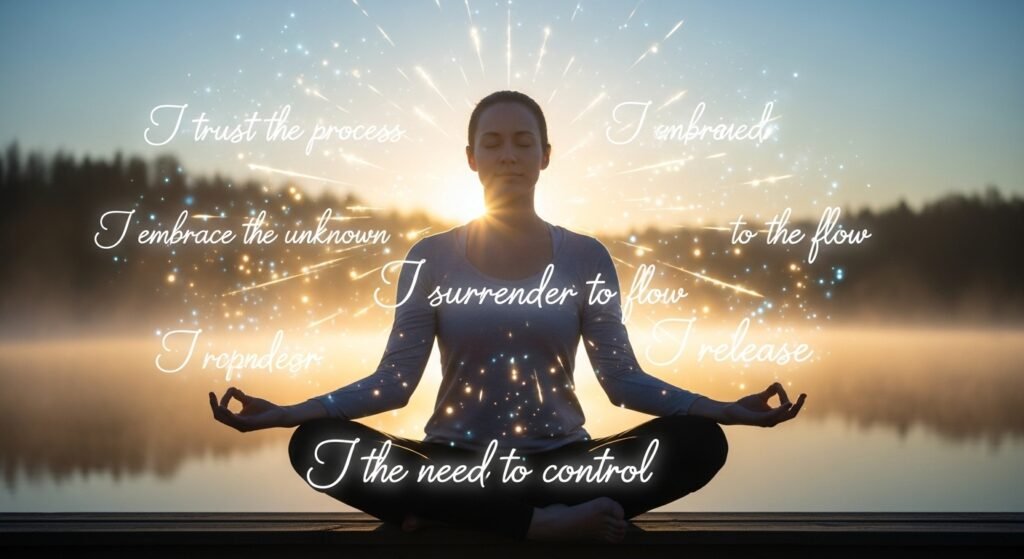
Your subconscious mind runs on programming developed throughout your life. If you grew up believing that you had to control everything to stay safe, your subconscious will resist surrender even when your conscious mind wants to let go.
Create affirmations that reprogram these deep patterns. Some powerful examples include:
- “I trust that the universe is always working for my highest good”
- “I release control and allow divine guidance to flow through my life”
- “Everything happens at the perfect time for my growth and joy”
- “I am safe to let go and trust the process”
- “Universal wisdom guides me better than my limited perspective”
Repeat these affirmations daily, especially when you notice yourself trying to control outcomes. The key is feeling the truth of these statements rather than just saying the words. Imagine what it would feel like if you truly believed the universe had your back.
Over time, these new beliefs will override old programming that says control equals safety. You’ll naturally start trusting the process because your subconscious mind accepts surrender as beneficial rather than dangerous.
6. Surrender Through Breath Work and Body Awareness
Your body holds tension from trying to control life’s outcomes. When you’re gripping tightly to specific results, your muscles literally contract. This physical tension reinforces mental resistance to surrender.
Practice conscious breathing to release this stored tension. Take slow, deep breaths while imagining you’re breathing out the need to control. With each exhale, let go a little more. Feel your shoulders drop, your jaw relax, and your belly soften.
Body scan meditations help you identify where you hold control patterns physically. Lie down and mentally scan from your toes to the top of your head. Notice any areas of tightness or discomfort. Send breath to these spots while setting an intention to release whatever you’re holding onto.
Many people hold control in their necks (carrying the weight of responsibility), their jaws (gritting teeth through challenges), or their stomachs (gut reactions to uncertainty). As you release physical tension, you’ll find it easier to let go mentally and emotionally.
7. Create Space for Universal Guidance Through Silence

Universal guidance often comes as subtle intuition rather than dramatic signs. When your life is filled with constant noise—whether from devices, activities, or mental chatter—you might miss these gentle messages.
Build regular periods of silence into your day. This might be a quiet walk in nature, sitting in meditation, or simply turning off all devices for an hour. In these peaceful moments, pay attention to any insights or feelings that arise.
You might notice a sudden urge to call someone, a random idea for solving a problem, or a feeling of which direction to take. These intuitive hits are how the universe communicates with you. The more you honor and act on them, the stronger this guidance becomes.
Some people receive universal guidance through dreams, synchronicities, or repeated number patterns. Others feel it as physical sensations or emotional shifts. Trust whatever form resonates with you rather than expecting guidance to arrive in a specific way.
8. Transform Challenges Into Trust-Building Opportunities
Every challenge contains an invitation to trust the process more deeply. When things don’t go according to your plans, you can choose to see it as evidence that life is unfair, or you can look for the hidden gift within the difficulty.
Start reframing obstacles as redirections rather than roadblocks. Maybe you didn’t get the house you wanted because a better one is coming available next month. Perhaps a friendship ended because you both needed to grow in different directions. What initially appears as failure might be the universe steering you toward something better.
This doesn’t mean you should passively accept harmful situations or avoid taking protective action. Trust the process by responding to challenges from your highest wisdom rather than reacting from fear or anger. Ask yourself: “How can I handle this situation in a way that serves everyone’s highest good?”
The more you find gifts within difficulties, the easier it becomes to trust that even unwanted experiences serve your growth and evolution. This perspective transforms you from a victim of circumstances into a conscious co-creator with the universe.
9. Practice Gratitude for What Is, Not Just What You Want

Gratitude is a powerful surrender tool because it shifts your focus from what’s missing to what’s already blessed in your life. When you appreciate what exists now, you stop pushing against reality and start aligning with it.
Create a daily gratitude practice that goes beyond surface-level thankfulness. Instead of just listing good things, explore why you’re grateful and how these blessings serve your growth. Maybe you’re thankful for a challenging relationship because it’s teaching you patience. Perhaps you appreciate a job loss because it’s forcing you to discover your true calling.
Extend gratitude to things you previously judged as negative. Thank your anxiety for trying to protect you, even though you’re ready to handle uncertainty with courage. Appreciate past mistakes for the wisdom they provided. This radical gratitude helps you see that everything in your life serves a purpose.
When you’re genuinely grateful for your current circumstances, you create space for even better things to flow in. Gratitude is magnetic—it attracts more experiences worth appreciating.
10. Trust the Process by Taking Inspired Action
Surrender isn’t passive waiting for things to happen. It’s about taking action from a place of trust rather than force. Inspired action feels good while you’re doing it, even if the outcome remains uncertain.
Learn to distinguish between inspired action and effortful pushing. Inspired action flows naturally from your intuition and aligns with your values. You feel energized and excited, even when the task is challenging. Effortful pushing comes from fear or desperation. You feel drained and anxious, trying to force outcomes through sheer willpower.
When you’re unsure whether an action is inspired, check in with your body. Does thinking about this step make you feel expanded or contracted? Do you feel drawn toward it or like you “should” do it? Trust your energetic response over your mental analysis.
Take one inspired action each day without attachment to results. Maybe you feel called to reach out to an old friend, explore a new creative project, or simply rest when you usually push through fatigue. These small acts of trust build your confidence in universal guidance.
Embracing Your Journey of Surrender
Learning to surrender to the universe is not a destination but a lifelong practice. Some days, you’ll feel completely aligned with divine flow. Other days, you’ll catch yourself white-knuckling your plans and expectations. Both experiences are part of the journey.
Be patient and compassionate with yourself as you develop trust in the process. Each time you choose surrender over control, you strengthen your connection to universal guidance. You discover that letting go doesn’t make you powerless—it connects you to a power greater than your individual will.
The most beautiful aspect of surrender is how it transforms not just your results, but your entire experience of being alive. Instead of constantly swimming upstream against life’s current, you learn to flow with it. You find ease in uncertainty, peace in not knowing, and excitement in letting the universe surprise you.
Start small. Choose one area where you’re ready to release control. Practice the techniques that resonate most with you. Trust that as you let go of your need to manage every detail, space opens for magic to enter your life in ways more wonderful than you could have planned.
The universe is always conspiring in your favor. Your job is simply to get out of your own way and allow the miracles to unfold.